

Voicd Research
Secure. Ethical. Trusted.
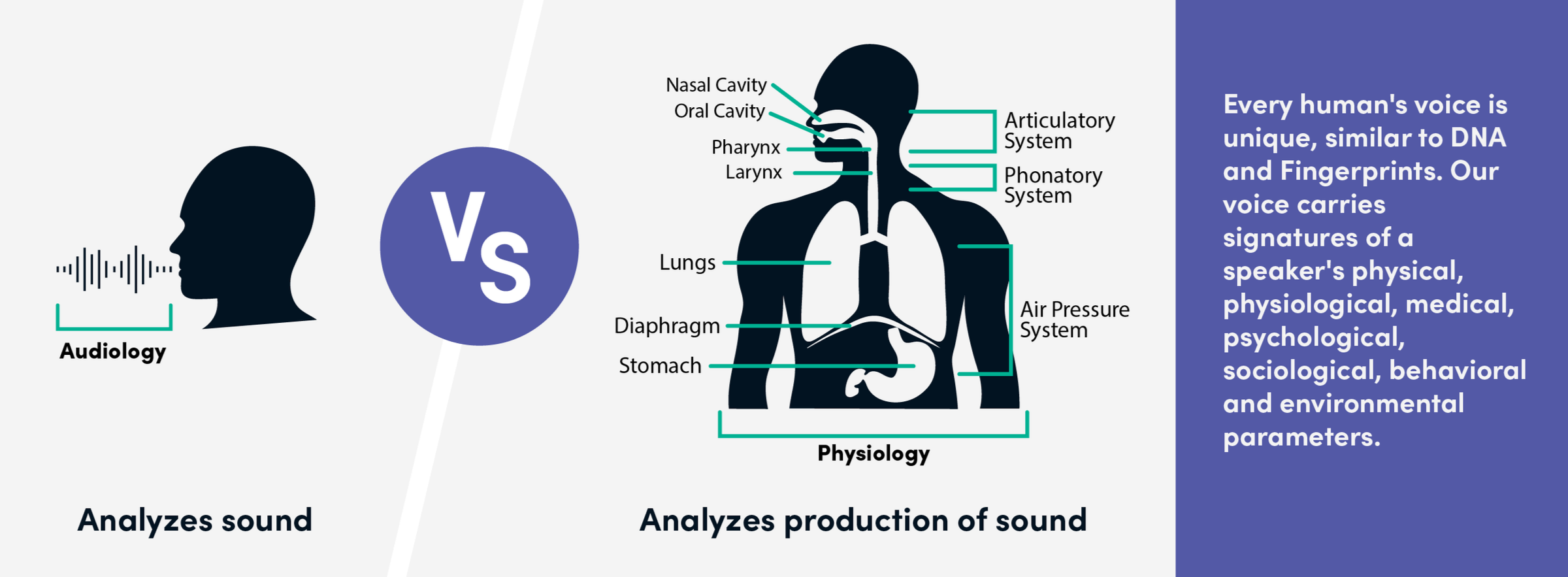
Voicd focuses on how speech is produced, not just how it sounds, enabling structured, interpretative analysis across use cases.
Grounded in Research
Physiology-first modeling of speech production
Independent, high-dimensional feature systems
Focus on interpretability and explainability
Validation across diverse datasets and real-world conditions
Our Research Focus

Security
Voice In The Past
Detects surface-level audio artifacts (e.g., glitches, unnatural smoothness, training signatures)
Signals degrade as generative models improve
Limited reliability on high-quality, real-world samples
Voicd in The Future
Models the biology of speech production
Evaluates consistency with human physiology
Identifies sources of mismatch
Designed to detect physiological inconsistencies in synthetic speech that artifact-based methods miss
Validation
Assessed for accuracy, consistency, and known error rates according to Daubert standards. Accepted as scientific evidence in a U.S. court. Platform performance is measured against published benchmark suites under internal quality assurance, including speaker verification and synthetic-speech refusal error rates. Detailed results are available to qualified evaluators under a mutual non-disclosure agreement

Healthcare
Voice In The Past
Voice signal established as an indicator of certain neurodegenerative diseases (e.g. Parkinsons or ALS)
High accuracy within small study datasets, but limited generalizability to real-world populations
Voicd in The Future
Models the physiological system that produces speech
Emphasizes underlying physiological mechanisms rather than dataset-specific correlations
Voicd provides a mechanism-based foundation for models to generalize across populations and real-world conditions
Status
Health applications are currently in the clinical research and validation phase. Commercial use will be pursued after securing regulatory approval